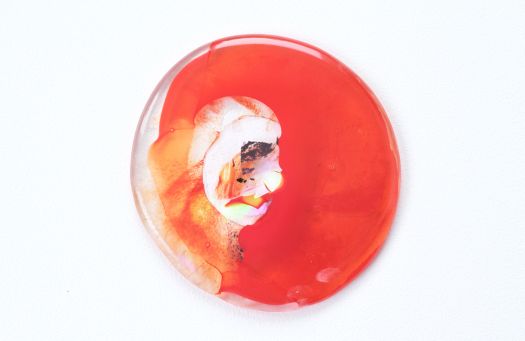
Fallout, 2025/6 Glass and Uranium Image courtesy of the artist
Manchester School of Art graduate and lecturer collaborate on new Castlefield Gallery exhibition
3 March 2026
Manchester School of Art Lecturer has collaborated with an MFA graduate on a new exhibition 'Broken Ecologies' at Castlefield Gallery
Manchester School of Art Lecturer and PhD student Alana Lake has collaborated with MFA graduate Deeqa Ismail on a new exhibition ‘Broken Ecologies’ at Castlefield Gallery which runs from March 15 - April 19th.
Through large-scale print works, film and sculpture, the exhibition reflects on power, protest, memory, and survival. Exhibiting together for the first time, Deeqa Ismail and Alana Lake’s works weave together narratives that are at once personal, political and historical. Their work is as vibrant as it is fragile, with layers of texture and imagery inviting us to consider how histories of erasure and survival continue to shape the present – especially in a moment marked by war, censorship, and the criminalisation of protest.
Fine Art Lecturer Alana Lake is a sculptor and PhD researcher who works across glass, ceramic, and metal. Speaking on the exhibition they said: “It reflects on power, protest, memory and survival in a moment marked by war, censorship and the erosion of civil liberties. My work in this exhibition considers how political and economic systems are lived, felt and materially embedded in everyday life. I find it difficult to make work in times like these. The exhibition has been shaped by a need to confront some of the most pressing and uncomfortable realities of the present, a position Deeqa and I were aligned on from the beginning”.
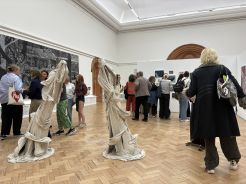
They explained how these themes are embedded materially in the exhibition: “Glass police truncheons carry a sense of fragility and precarity. In contrast, certain objects confront the viewer more directly, for example, a brass bullet installed at head height, titled Under Threat(2026). A marble baseball bat aligns a contemporary weapon with the material language of classical sculpture. Across the works, I use familiar objects associated with control, defence or threat and shift them through scale, material or placement so that they become confrontational.
Deeqa Ismail, whose work is centred around printmaking, sound and sculpture, also commented on how she implimented her practice onto these themes: “I took a particular interest in woodcut and reduction processes. I was drawn to the physicality of carving into the woodblock, the material’s resistance, and the way each mark becomes irreversible. The carved marks are made using carpentry tools that cut into the wood. These gestures can feel like acts of building, shaping, and forming structures, like infrastructure. But we are living through a time when infrastructures are being destroyed. As a result, the same marks can also indicate damage. That process mirrors many of the themes explored in Broken Ecologies: power, protest, archive, and survival. The act of cutting away feels connected to ideas of erasure and endurance, while the layering inherent in printmaking reflects how histories are built up, obscured, and revealed over time. Woodcut carries a long association with political and collective communication, so it naturally lends itself to addressing questions of resistance and care”.
Alana explained how their current PhD as Manchester School of Art has informed the important questions that exhibition poses: “The PhD has given me the time and structure to think more carefully about what I’m making and why. It has strengthened the connection between research and practice, and allowed for the sustained development of new work. The exhibition feels timely because the questions it raises are shaped directly by the challenging conditions of the present. The question ‘what is the role of the artist in times of crisis?’ emerged through the final chapter of my PhD and in dialogue with Hal Foster’s Death in America (October, Winter 1996), which reconsiders Andy Warhol’s Death and Disaster series through the lens of traumatic realism, a mode that acknowledges the persistent presence of death, shock and catastrophe in public life. It led me to reflect more directly on the artist’s position within a broader landscape of crisis, and on what it means to continue making work within that context”.
Deeqa, who graduated an MFA at Manchester School of Art last year, also commented on the impact it had on the exhibition and her wider practice: “My time at Manchester School of Art was formative. It has given me both the technical grounding in my practice and the critical framework to situate my work within broader contexts. I have become more confident in my relationship with materials and have also learned to take conceptual risks. The MA course was incredibly freeing for me, particularly as someone who works fluidly across multiple mediums at once. It’s important to push your practice when you’re in an environment that allows you to receive critical, constructive feedback. Alongside that, I felt a responsibility to help build a more visible and supportive community for Black and Brown students. The print room, in particular, was a space for exchange, where process is as important as the outcome. The team and the environment there have had a lasting impact on how I approach making”.
‘Broken Ecologies’ was co-selected from proposals made by Castlefield Gallery Associates, by Castlefield Gallery’s Head of Programmes, Matthew Pendergast, and guest selector, Curator, Cultural Producer, Art Consultant & Writer Cindy Sissokho.
Speaking on working with together with the gallery, Deeqa said: “Castlefield Gallery has been a supportive and considered space to exhibit in. The architecture allows the works to breathe, and the team have been generous with their time and insight throughout the build-up to the show. It has felt like a space that encourages conversation, which feels especially important for work engaging with artistic activism, collectivism and the bleak political sphere we are living through”.
‘Broken Ecologies’ opens officially on March 15th. However, you can book your tickets here to the Preview on Thursday 12 March here and the slow preview on Saturday 14 March here.
Find out more about the exhibition.
Find out more about Post-Graduate study at Manchester School of Art.